Author: redziedzic

  • Holistic Assessment of Social, Environmental and Economic Impacts of Pipe Breaks: The Case Study of Vancouver

    Abstract

    This paper presents a holistic assessment framework for the impacts of water distribution pipe breaks to promote environmentally sustainable and socially resilient cities. This framework considers social, environmental, and economic vulnerabilities as well as probabilities associated with pipe failure. The integration of these features provides a comprehensive approach to understanding infrastructure risks. Taking the city of Vancouver as a case study, the social vulnerability index (SVI) is obtained following the application of a cross-correlation matrix and principal component analysis (PCA) to identify the most influential among 33 selected variables from the 2021 census of the Canadian population. The Environmental Vulnerability Index (EVI) is evaluated by considering the park and floodplain areas. The Economic Vulnerability Index (ECI) is derived from the replacement cost of pipes. These indices offer valuable insights into the spatial distribution of vulnerabilities (consequences) across urban areas. Subsequently, the Consequence of Failure (COF) is computed by aggregating the three vulnerabilities with equal weights. Pipe probability of failure (POF) is evaluated by a Weibull model calibrated on real break data as a function of pipe age. This approach enables a dynamic evaluation of pipe deterioration over time. Risk is finally assessed by combining COF and POF for prioritizing pipe replacement and rehabilitation, with the final objective of mitigating the adverse impacts of infrastructure failure. The findings show the significant impact of ethnicity, socioeconomic indices, and education on the social vulnerability index. Moreover, the areas close to English Bay and Fraser River are more environmentally vulnerable. The pipes with high economic vulnerability are primarily concrete pipes, due to their expensive replacement costs. Finally, the risk framework resulting from the vulnerabilities and pipe break probabilities is used to rank the Vancouver City water distribution network pipes. This ranking system highlights critical areas requiring different levels of attention for infrastructure improvements. All the pipes and corresponding risks are illustrated in Vancouver maps, highlighting that the pipes associated with a very high level of risk are mostly in the south and north of Vancouver.

    Sinaei et al., 2025

    Water https://doi.org/10.3390/w17020252

  • Review of national policy instruments motivating circular construction

    Abstract

    Building construction, renovation, and demolition (CRD) waste represent about one-third-of global waste production. Implementing circular economy practices in CRD can significantly reduce waste as well as related impacts, such as greenhouse gas emissions. Yet the effect of different types of policies in promoting construction circularity requires further investigation. The objective of this paper is to review the range of policy instruments applied by different countries and investigate how effectively they promote circularity. Based on a literature review, thirty-seven instruments were identified and classified into five types: regulatory, economic, technical, operational, and communicative. The implementation of each of these instruments was investigated for 19 countries, selected to represent each of the world’s regions as defined by the World Bank, including: Barbados, Brazil, Bulgaria, Canada, China, Egypt, Germany, India, Israel, Japan, Kyrgyz Republic, Mexico, Morocco, Portugal, Qatar, Republic of Korea, Sri Lanka, Thailand, and United States. In each region, countries were selected to represent the full scope of CRD generated per capita. Economic, technical, operational and specific CRD regulatory instruments are moderately correlated to CRD waste recovery. In high income countries CRD regulations are the most correlated with recovery, whereas in middle income countries technical instrument implementation is more correlated.

    Dziedzic et al., 2025

    Resources, Conservation and Recycling https://doi.org/10.1016/j.resconrec.2024.108053

  • Challenges in Inter-organizational Knowledge Transfer for the Life Extension of Oil and Gas Facilities

    Abstract

    The aging process of oil and gas facilities poses unique challenges in risk management, especially when operators have the intention to extend their service life. Facility extension has been an object of increased interest in the oil and gas industry because of its benefits. Researchers have identified several organizational issues that can impact this process. Among these, knowledge transfer is a critical aspect in contexts involving facility transfer between companies. The goal of this research is to investigate the inter-organizational knowledge transfer (IKT) elements and mechanisms of oil and gas facilities acquired for life extension and understand their main challenges. A qualitative case study was carried out on the transfer of an oil and gas offshore production facility between companies. The study identified 22 key elements and 27 challenges that the acquiring operating company faced during the IKT process. This case study provides valuable insights that can guide other organizations in similar situations, helping them better manage the IKT process, mitigate potential risks, and ensure smoother operations during and after facility transfer. It can also support the development of future frameworks by managers and oil and gas regulators to evaluate IKT issues as part of oil and gas facility life extension.

    Ferreira et al. 2024

    IEEE Transactions on Engineering Management DOI: 10.1109/TEM.2024.3361797

  • Introduction of a carbon footprint assessment in the oil and gas facility life extension decision-making process

    Abstract

    In large oil and gas producing countries, extraction and processing activities, including upstream activities, can represent a large share of domestic emissions. As oil fields approach their expected service life and reach depletion, energy use and GHG emissions increase per unit of produced oil, shifting operations away from their optimal point. Thus, it is paramount that oil field life extension decisions account for energy use and GHG emissions. However, many facilities are having their service life extended without considering this energy inefficiency and previous life extension decision making studies have neglected GHG emissions. Addressing this issue, this paper proposes the inclusion of a carbon footprint assessment within the evaluation of oil and gas offshore production facility life extension. The carbon footprint assessment adds an environmental lens to the evaluation of ageing, formerly evaluated according to material degradation, obsolescence and organizational issues. An eleven-stage framework is proposed to systematize the ageing related carbon footprint assessment and support life extension decision-making: (1) Objective definition, (2) Scope definition, (3) Field conditions description, (4) Scope breakdown into manageable portions, (5) Detailed data collection for each process and subsystem, (6) Input and output definition for each process and subsystem, (7) Process modelling, (8) Methodology definition for energy demand and inefficiency estimate, (9) Monitoring indicator definition, (10) Performance evaluation, and (11) Interpretation of results. The proposed framework is applied to a hypothetical case study, developed with data from a typical oil and gas offshore production platform operated in Brazil. Two LE improvement strategies were simulated, i.e. reducing the number of gas turbines, and increasing the export of natural gas. Both alter the modus operandi of the compression system and do not require additional equipment installation. These strategies resulted in a combined reduction of 922,000 tCO2 during the extended 10-year operation. This outcome demonstrates that by applying the framework opportunities for reducing energy use and GHG emissions during life extension can be identified and quantified, facilitating life extension decision-making.

    Ferreira et al., 2024

    Geoenergy Science and Engineering

  • Analysis of factors driving water main breaks across 13 Canadian utilities

    Abstract

    Deterioration of water infrastructure is a global challenge that jeopardizes water system ability to deliver water safely. While various factors affect watermain failure, previous studies have focused on common pipe attributes or general protection strategies. The main objective of this study is to examine the relationship between pipe break characteristics and system properties. Comprehensive data from thirteen Canadian water systems (over 60,000 failures) are examined with correlation and chi-squared analyses. Joint and fitting failures are most likely for pipes aged 20 years or less, and universal joints are most associated with joint failure. Pipes in clay and sand soils are more likely to break due to improper bedding and differential settlement, respectively. Furthermore, in the summer, accidental breaks of asbestos cement pipes are more likely, as are failures of pipes with collar joints and coal tar lined pipes. By exploring these relationships, the paper provides insights into opportunities for reducing water main failure, through improved design, maintenance and rehabilitation.

    Gharaati and Dziedzic, 2024

    Environmental Systems Research https://doi.org/10.1186/s40068-024-00334-x

  • Obsolescence management for offshore oil and gas production facility life extension

    Abstract

    The extension of the service life of offshore oil and gas production facilities has been an object of increased interest because of its benefits. In previous work, the authors proposed a guideline for managing the life extension process of oil and gas facilities, however without integrating obsolescence management. The main objective of the present study consists of develop a framework to guide the evaluation and management of asset obsolescence in the context of life extension, considering the concept of obsolescence as having four types of drivers – unavailability from manufacturers, new requirements or demands, technological or technical changes, and new conditions or needs. A framework with six stages of obsolescence management process was proposed and validated with a case study. Because no single request submitted to the Brazilian oil and gas regulator of a facility considering life extension had complete information to perform the obsolescence evaluation, a hypothetical case study was developed with a combination of information from real offshore production facilities. Results demonstrate that the framework: (i)transforms the assessment and management of obsolescence into a systematic process that identifies priority impacted elements and, (ii)based on the risks associated with their obsolescence, supports the definition of the most appropriate decision.

    Ferreira et al. 2023

    Ocean Engineering https://doi.org/10.1016/j.oceaneng.2023.115388

  • Multivariate Regression Models for Predicting Pump-as-Turbine Characteristics

    Abstract

    Installing pumps as turbines (PaTs) in water distribution networks can recover otherwise wasted energy, as well as reduce leakage caused by high water pressure. However, a barrier to their implementation is the lack of information on their performance in turbine mode. Previous studies have proposed models to predict PaT characteristics based on pump best efficiency points (BEPs), using regressions with one or two dependent variables, or more complex artificial neural networks (ANNs). While ANNs were found to improve the accuracy of predictions, these models are known to be unstable with small datasets. Other types of regressions with multiple variables have not been explored. Furthermore, because only small datasets are available to train these models, multivariate regression methods could yield better results. The present study develops multivariate regression models to predict BEPs and characteristic curves of PaTs. A database of 145 BEPs and 196 characteristic curve PaT experimental records was compiled from previous literature. Twenty-four types of multi-variate regressions, as well as ANN were compared, with dimensioned and dimensionless versions of the datasets. The multivariate regression models consistently outperformed previous models, including ANN. The R2 of the head and efficiency curves were 0.997 and 0.909, respectively. Results also showed that XGB regressors and a dimensionless dataset yielded the best-fit models overall. The high accuracy of the models, combined with their lower computational cost compared to ANN, make them a robust solution for selecting PaTs in practice.

    Brisbois and Dziedzic, 2023

    Water https://doi.org/10.3390/w15183290

  • Efficiency enhancement of leakage detection and localization methods using leakage gradient and most affected sensors

    Abstract

    Leaks cause substantial economic and water losses for water distribution networks (WDNs). Thus, it is imperative to detect and localize leaks. This paper proposes an efficient set of methods for detecting and localizing leaks, with three main steps: model calibration, leak detection, and leak localization. First, demands, pipe diameter, and pipe roughness in the hydraulic model are calibrated with a genetic algorithm (GA). The X-bar method and cumulative sum control chart are then implemented to detect pipe bursts and incipient leaks, respectively. Lastly, a reduced search space is defined and searched with a GA to locate leaks. The proposed strategy was tested on the hypothetical WDN of L-Town from the Battle of the Leakage Detection and Isolation Methods. Results show that 12 of 19 leaks were detected, and 8 of the 12 leakages were accurately located. Compared with other approaches, the proposed approach is more efficient and equally effective.

    Cai et al. 2022

    Canadian Journal of Civil Engineering https://doi.org/10.1139/cjce-2023-0176

  • Ethics of Water Infrastructure Reinvestment

    by: Rebecca Dziedzic

    The fact that infrastructure does not last should not come as a surprise. It is clear in our houses and on our streets. Yet, there is a global infrastructure funding gap. This gap widens not only due to population growth but also due to the failure to proactively renew and maintain ageing assets. Specifically for water infrastructure, consequences of an investment backlog can range from small service interruptions to more serious threats to health and safety, as experienced in Walkerton, ON in Canada and Flint, MI in the US.

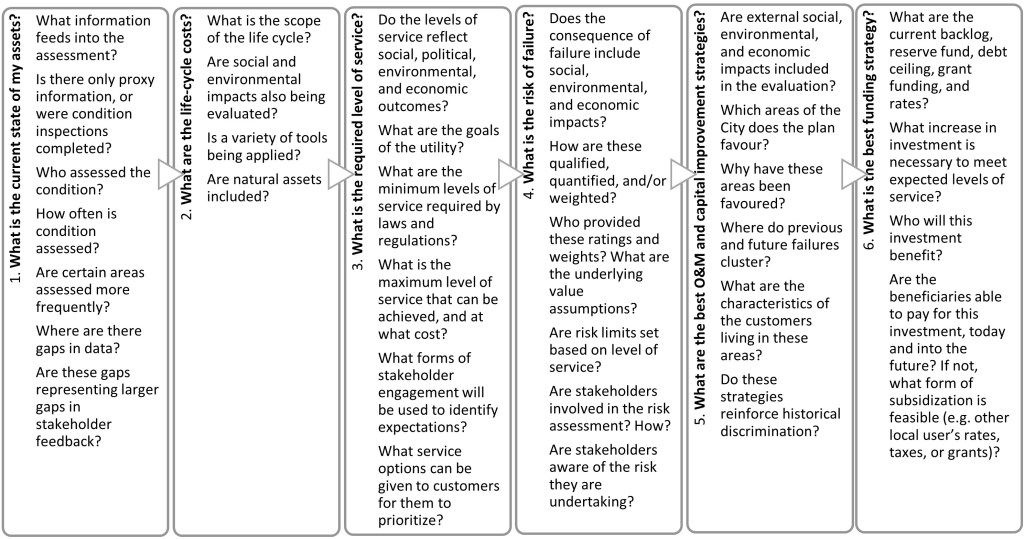
    Whether or not the trade-off between infrastructure investment and health and safety is made explicit, it exists. The assumptions, biases, and potential pitfalls of current asset management practices is not always clear. According to the Water Environment Research Foundation, asset management practices should answer the following six big questions:

    • What is the current state of my assets?
    • What are the lifecycle costs?
    • What is the required level of service?
    • What is the risk of failure?
    • What are the best O&M and capital improvement strategies?
    • What is the best funding strategy?

    Even though these questions should be answered based on detailed data and stakeholder engagement, assumptions are usually made to simplify the process. If decisions lack inclusion and diversity, however, they may continue to favor affluent areas. Furthermore, the questions themselves focus on financial impacts instead of broader social and environmental impacts. If the concerted efforts of municipalities and engineers reinforce systemic discrimination and other social and environmental impacts, then reinvestment plans should be reviewed with the same attention to detail and external impacts as multi-million-dollar construction projects, even if plans are eventually completed in a piecemeal fashion.

    For example, A CBC news investigation in 2015 revealed that two thirds of all First Nations communities in Canada have been under at least one drinking water advisory at some time in the last decade. It also found that 400 out of 618 First Nations communities had some kind of water problem between 2004 and 2014. On the other hand, communities with municipal service agreements are 11% less likely to be under a boil water advisory.

    In order to highlight how existing biases can skew outcomes, make assumptions more explicit and consider systemic impacts, the questions listed in the figure below should be asked at each stage of asset management.

    This discussion and the proposed list of questions are based on a chapter of the same title, published in “Ethical Water Stewardship” (Stefanovic, I. and Adeel, Z., 2021). For more details and general recommendations, please refer to the original chapter.

  • Analyzing water customer service expectations: A case study of the City of Guelph

    Abstract

    The present study applies a business model framework to a water utility using a case study. A survey was developed and conducted with residential water customers in the City of Guelph, ON, Canada, with the objective of assessing their expectations in order to improve the business. Preferences differed by user type, underlining the benefit of distinguishing between customer segments (or user types) and customizing messaging. Users were not aware of all services covered by their water bill, and although expecting high quality services they did not support rate increases. Stakeholder collaborations could be used to improve awareness, offer decentralized solutions, and resolve issues collectively.

    Dziedzic and Karney, 2016

    Utilities Policy https://doi.org/10.1016/j.jup.2016.06.002